The Results of the Learning Style Inventory
By: Kayla Cunningham
Education 551-0500, Grand Canyon University
August 2, 2021
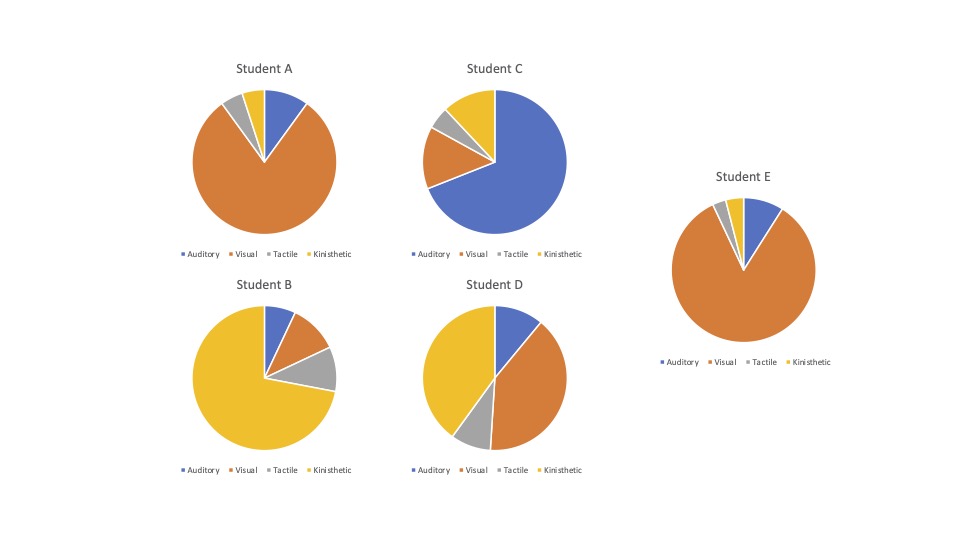
Effectively using media tools to communicate data is a great way to collaborate about and strategically review student data with colleagues. As a teacher, it is important to know how to gather and interpret student data. It is important to understand that each student is unique and different. Using the data collected from the learning style inventory in Topic 2, I created a visual representation of the group’s learning styles. The results of the learning style inventory for each unique student was as follows:
- Student A: Visual Learner
- Student B: Kinesthetic learner
- Student C: Auditory Learner
- Student D: Kinesthetic learner and Visual Learner
- Student E: Visual Learner
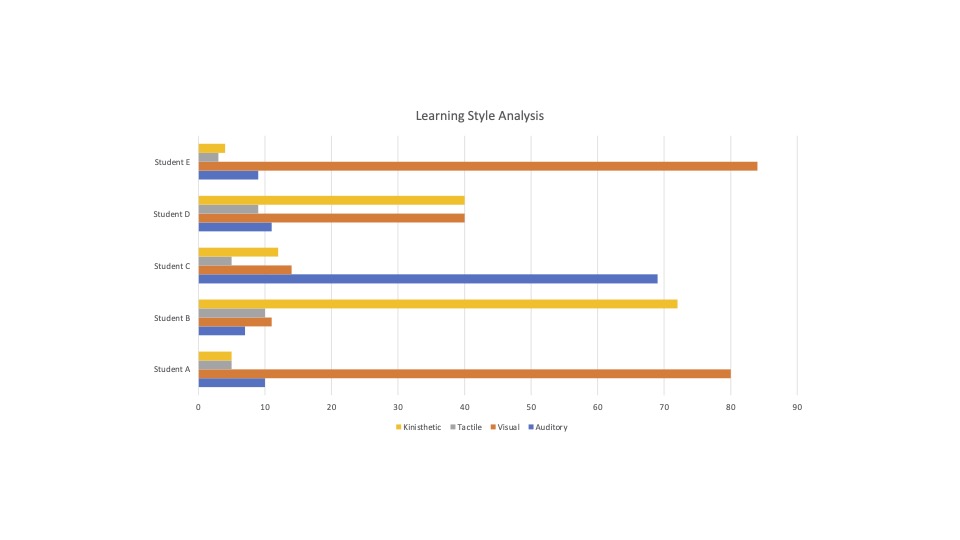
The above graphs were compiled to visually represent the various learning styles present for the five students previously chosen in Topic 2. The students I chose were all newer to our program, and they all ranged from mild to severe on the Autism spectrum. Out of the five students that I performed the learning style survey with and analyzed, it was clear that the students were mostly visual learners, seconded by kinesthetic learning styles. Visual learners, which made up the majority of the student’s based on the charts, need to see the information presented to them before they can learn it. These students typically do best by sitting at the front of the classroom, writing down notes, and reading stories out loud. Students do best by hearing things, not just seeing them presented. The kinesthetic learners are very physical and need movement and touch to learn. These learners need to move and do well with the manipulation of objects. It would be disadvantageous to have them sit and listen to a lecture for long extended periods of time. After determining my classes learning styles, I can become a more effective teacher and improve their development and learning. I know my class not only needs to hear information, but they also need to have a hands-on learning experience where they have the opportunity to practice and manipulate materials.
Using the knowledge from the graph collected, I would model assignments to my class and incorporate activities for my Visual learners such as vocab flash cards, matching games, pictures on my PPT slides, charts and graphs, video like YouTube, and computers. Between the lecture and activities, I would allow movement as much as possible for my kinesthetic learners, especially during those longer stretches, because I know my class needs to get up and move. I will integrate hands on learning activities such as puzzles, model kits, and allow them to choose their project-based learning activities. There are many great resources available as a teacher for lessons that help to give ideas based on your topic and grade. I personally love providing differentiated instruction and allowing students a choice when it comes to their learning. Project-based learning is a great option, because it gives students a voice and allows students to take something they are interested in and then brainstorm and address the problem (Educators of America, 2021).
Based on the graph, it is clear that the students all have learning preferences, but they also learn in all four ways: Auditory, visual, kinesthetic, and tactile. No student was 100% one style of learning. “Few things in life fall into easily delineated schema, and learning preferences are no exception. In fact, studies estimate that somewhere between 50 and 70 percent of the population have affinities to several different styles of learning. These people are called “multimodal learners” and tend to succeed in classroom settings that engage them with multiple learning styles alternately or in concert with one another” (The University of Kansas, 2021). This means it is important to incorporate all four learning styles into your lesson.
In order to meet the needs of all my students, I need to vary my instruction. As an example, if I was teaching the history of Christianity in Ancient Rome, I would open my lesson with a quick critical thinking question on the board based on the last lesson or topic that would get students to read their previous notes and write a short answer. Once students handed in their 3×5 cards with the answers, I would show a short video clip of Ancient Rome. Before I started my presentation, I would hand out a paper with a lecture summary and/or incomplete notes for students to follow along. This would be followed by a short lecture and PPT with pictures and bullet points. I would end the lecture, allow students to get up and move around the classroom to answer discussion questions, which would then lead into a hands-on activity. This short lesson would appeal to the four different learning styles present in the classroom. Using a lesson that meets the needs of all learners will increase the student’s level of interest and motivation. This will lead to student engagement and understanding of the material.
Differences are vital to a class, because they promote learning in the classroom, and it will provide you with the opportunity to develop your student’s confidence and motivation (Lucariello, et al., 2016). Different learning styles and understanding the differences that make up a class can help you as a teacher when planning meaningful tasks and assignments. Every student has strengths and weaknesses and understanding how individuals and the classroom as a whole operates, will allow you to play to those different strengths as a teacher.
Teachers need to know their class. Learning about your students and building that background history with them is essential for a successful classroom. A great way to do this is through a student’s learning profile, which help teachers gain information about a student’s gender, culture, learning styles, and intelligence preferences (Colquitt, et al., 2017). It is important to ensure the readiness of your students. That means you need to know what they have already learned. What are their weaknesses? What do you need to re-teach or help fill in the gaps? There are many ways to asses a student’s readiness which allows you as a teacher to assign meaningful work that is appropriate for each student’s skill level. “Lesson planning and instruction of content, process, and product are only half of the equation. The other part is how students respond through readiness, interests, and learning profiles. Effective differentiation and, by extension, student learning, must make the tasks and focus appealing to students” (McCarthy, 2014). KWL charts, formative assessments and pre-tests and observation are all excellent ways to evaluate a student’s readiness to learn. Based on their skill level, teachers should scaffold their lessons and activities to ensure all students learn.
It is important to evaluate what a student has learned and taken away you’re your lesson. This means it is vital as a teacher to continually evaluate your students to ensure your objectives and learning goals and targets have been met for the lesson (short term: that day and long term: the unit). Examples of readiness tools to help track student progress are exit tickets, Flipgrid responses, journal entries, 3×5 card critical thinking questions at the start or end of a class, observation checklists, short quizzes, and discussion or student questions (McCarthy, 2014).
Every year I add to a large binder of lessons, PPTs, readings, and activities I have tried with my class. I know that not every year and class with be the same. My students and class make up will be different each other. I like having a “play book,” especially for the initial first weeks of class. However, in order to determine the execution of my lesson, I need to learn about the students that make up that class. Once I learn about how they learn and their interests, I can pick and pull and adapt my previous lessons to fit their needs. It is easier to fill some of the learning gaps and deficiencies with topics like history and Bible studies, but it is especially important to be aware of reading and writing gaps for these subjects. If learning gaps are present, I will differentiate and scaffold material, while addressing the skill gaps. For reading deficiencies, I can provide readings at different levels or hold guided reading groups. Differentiation helps to ensure that no student is left behind in their education, and that students have the opportunity to grow.
Once learning objectives are identified and met, it is important to test for understanding and mastery of that content. For authentic assessment, formative assessment, and projects, I generally have a bank of ideas students can choose from that can demonstrate the students did indeed learn the objectives and standards of the unit. I love giving students the opportunity to choose their final project, based on what interests them. I offer several activity choices, that appeal to all learning styles. Students are always more engaged when they are given the opportunity to choose their project. Examples of projects: build a website (like Weebly), produce a podcast, write an essay, blog, or creative works (story, poem, song, journal, etc), perform a skit/play, conduct an interview, give a presentation, create an infographic, PPT slide, or design a 3D object. There are many other great projects that you can give as an option for students to choose from. As a teacher, you can also offer students the opportunity to work individually, with a partner, or a group.
Another great method for teaching content is through group work. Group work is a great way for students with diverse skills to collaborate and bring their experiences and skills to the table for the betterment of the group. Students can contribute to their groups in meaningful ways, which in turn enables students to bring their strengths and interests forward. Students can apply their skills during group projects, and it promotes social skills. “Another strength of heterogeneous groups is addressing skill gaps that prohibit access to content. Some solutions for students include providing them with materials at different reading levels, or having peers read aloud material for those with lower reading levels. Such strategies enable all students to assist with application and critical thinking of content on an even playing field. During these group activities, teachers can pull out individual or small groups of students for strategic coaching in needed areas” (McCarthy, 2014).
It is my goal to address all learning styles when developing and implementing assessments for the students. Personally, I try and use multimodal learning options to benefit multiple learning styles (Dene Poth, 2019). I have a unique classroom setting, and I want to ensure all students learn, not just a few students. I believe students benefit from learning in multiple ways. No student is the same, or learns the same. Lessons can easily offer a variety of ways to engage a student in the content you are teaching.
Assessment data, evaluations, and the learning styles survey date, will all be used to continually improve my own teaching. It is my job to ensure students are learning, and that means I need to research and find the best practices possible that help me achieve my objectives as a teacher. The collection of data is extremely important as a teacher to assess learning styles and needs of a classroom. This helps you gage whether changes need to be made to your lessons. The learning styles inventory is a great tool for planning. As a teacher, it is essential to evaluate and use the students’ strengths, interests, and needs for growth to influence your instruction.
Resources
 Technology-Based Resources